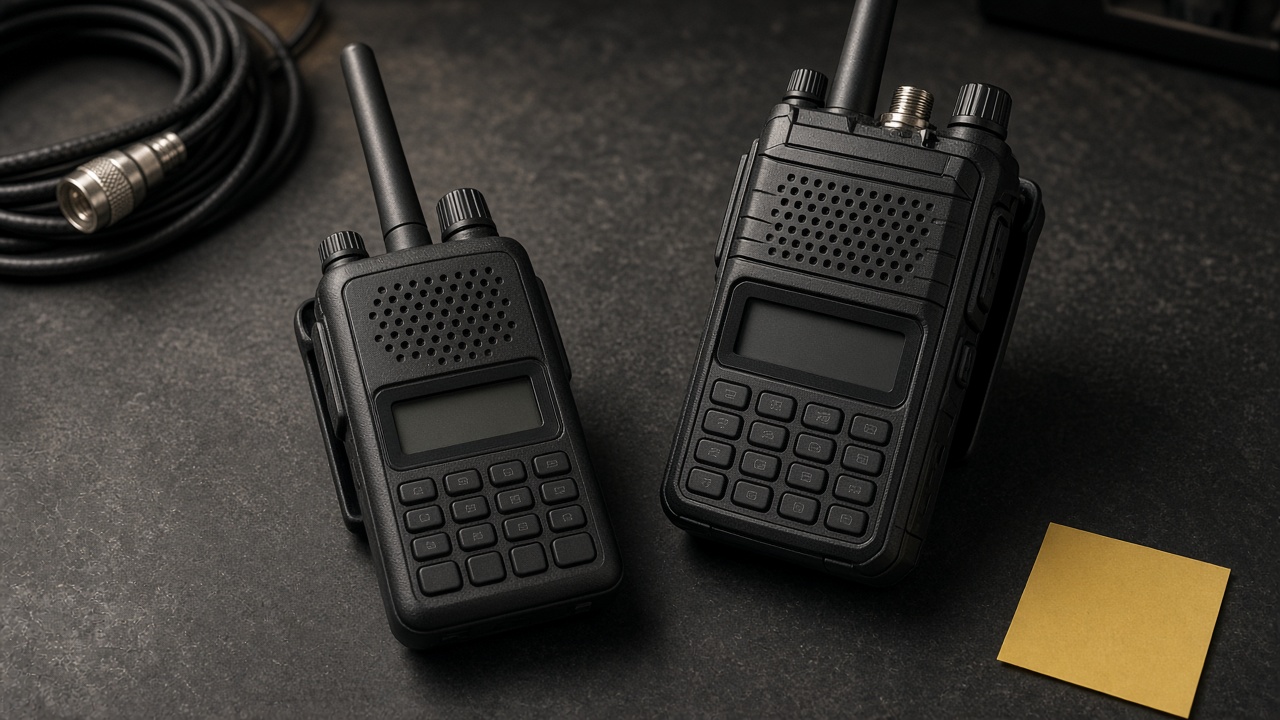
A dual band vs tri band radio is a smaller decision than the ads make it. One covers two amateur bands. The other covers three.
Most of the time those bands are 2 meters and 70 centimeters. A tri-band radio built for the US usually adds 1.25 meters on top of that pair. If nobody around you uses 1.25 meters, the third band is a quiet knob.
You still program the repeater, the offset, and the tone. Extra coverage does not do that for you.
What Dual-Band Usually Means
Two meters runs from 144 to 148 MHz in the United States. Seventy centimeters runs from 420 to 450 MHz. Those are the bands on almost every local repeater, simplex channel, and public-service net.
A dual-band handheld or mobile is built for that pair. You store the local machines, you listen on one band, and you talk on the other when the radio allows it. For a lot of hams this is the radio in the car and the radio in the bag.
The radios are common, the antennas are common, and a club member can usually walk you through the menu. That is the practical advantage.
What the Third Band Adds
On a US tri-band radio the third band is usually 1.25 meters, 222 to 225 MHz. Some cities have active repeaters there. A lot of places do not.
Many countries have no 1.25-meter amateur allocation. A radio sold as tri-band somewhere else may add 6 meters or 23 centimeters instead. Read the band ranges printed for that model before you assume you are buying the 220 MHz band.
The third band earns its place when you have already looked up the local machines and found some. It is a weak backup for a busy 2-meter repeater if that backup has nobody on it.
How offset and tone work is covered with ham radio repeaters. If the radio is going in a car, the mount and the power lead are a mobile ham radio job.
Router Comparisons Are a Different Hobby
You will see write-ups that treat a tri-band ham radio like a tri-band Wi-Fi router. They talk about offices, stadiums, and a house full of gadgets. That is a different radio service.
A ham radio does not get faster because it can tune another amateur band. It gets another place to transmit, if your license allows it and if someone is listening. Congestion on 2 meters is a busy repeater. It is not a living room full of phones.
Ignore any claim that borrows a percentage from the router market and pastes it onto a handheld. Those numbers were never about amateur radio.
How to Choose
Listen first. A week with a scanner, or with the radio you already own, tells you which bands your town uses. If everything you care about is on 2 meters and 70 centimeters, get the dual-band radio and get on the air.
Pick the tri-band radio when you know 1.25 meters is alive near you, or when you specifically want that band. You will have more channels to program. That is a fair trade once you want the band. It is a chore if you do not.
Either way, the antenna and the local listing matter more than the badge on the case. If you are still sorting out what these ranges are, start with HF, VHF, and UHF.
Features That Actually Matter
More bands do not mean a better receiver. Some dual-band radios scan more sensibly, sound cleaner, or have a simpler memory layout than a tri-band radio on the same shelf.
Cross-band repeat, dual watch, and a large memory show up on both kinds. Read the manual for the radio in your hand. Do not assume the extra band comes with the feature you wanted.
The radio you will enjoy is the one you can program for a local repeater without a fight. Buy that one.
Frequently Asked Questions
What is the difference between a dual-band and a tri-band ham radio?
A dual-band radio transmits and receives on two amateur bands, almost always 2 meters and 70 centimeters. A tri-band radio adds a third band. On radios sold for the United States, that third band is usually 1.25 meters. The extra band helps only when operators and repeaters near you actually use it.
Is the 1.25-meter band worth a tri-band radio?
It is worth it when your area has 1.25-meter repeaters or simplex activity you want to join. In plenty of towns that band is nearly empty. In many countries it is not an amateur band at all. Check a current repeater directory before you decide.
Will a tri-band radio do better in a busy city?
Only if the people you want to reach are on that third band. A crowded 2-meter repeater does not get clearer because your radio can also tune 1.25 meters. Use a quieter machine, or simplex, on a band someone is actually monitoring.
Can a Technician use a dual-band or tri-band radio?
Yes. Everyday FM work on 2 meters, 1.25 meters, and 70 centimeters sits inside Technician privileges in the United States. The radio still has to be on a frequency and mode your license allows. A General upgrade is about HF privileges, not about unlocking a third VHF band.