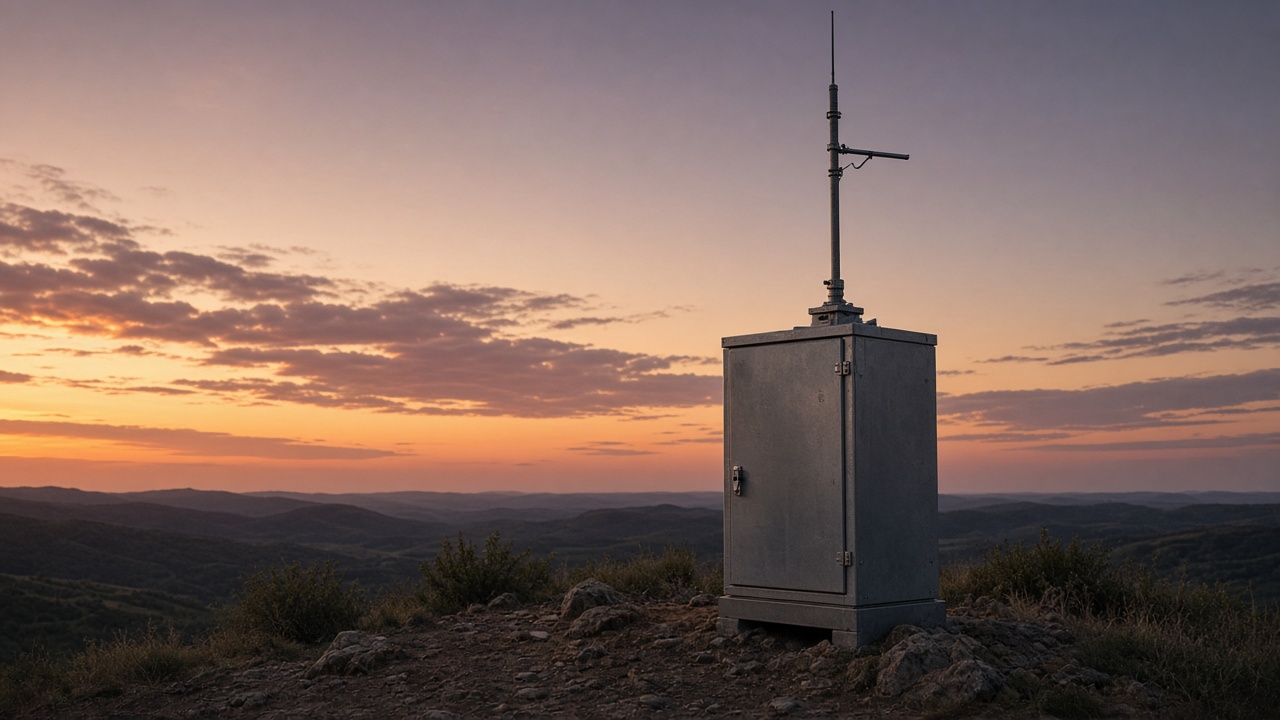
Ham radio repeaters are relay stations. Your radio talks to the machine. The machine talks to everyone else, louder and from higher ground than you can manage with a handheld.
That is why a small radio covers a town. VHF and UHF are mostly line of sight. A repeater on a ridge, a tower, or a tall building can see past the hill that blocks two handhelds on the street.
You use one by programming three facts: the output you listen to, the offset you transmit on, and the tone that opens the receiver.
Input, Output, and the Hill
You transmit on the input. The repeater receives that signal, and at the same time it retransmits on the output. Everyone else listens to the output. Your radio does the split for you once the channel is programmed.
The site is the product. Height beats wattage for this job. A handheld on a rubber duck can work a machine that a mobile across town cannot reach, if you are the one with a view of the hill and they are in a hole. When the path is the problem, it is a ham radio signal problem, and more offset settings will not fix it.
Most of the radios people bring to a repeater are dual-band handhelds or mobiles. What that second band is for, and when a third band is worth the price, is dual-band vs tri-band. Either one can work a repeater if it will take an offset and a tone.
Offset, Tone, and the Duplexer
In the United States the standard offset is 600 kHz on 2 meters and 5 MHz on 70 centimeters. The listing tells you the direction, plus or minus. A few machines use a different split. Trust the listing over a rule of thumb when they disagree.
The duplexer is the can of filters at the site. Transmitter and receiver share one antenna. The offset gives the filters room to work, so the repeater does not hear itself.
CTCSS is a continuous low tone, often called PL after the old Motorola name. DCS is a digital code. You send it the whole time you transmit. The repeater opens if the tone matches and stays quiet if it does not. Tone keeps a distant machine, or the noise floor, from keying the transmitter all day.
Program the output frequency, the offset direction, the offset amount, and the tone. Then listen. If you hear the repeater and a kerchunk with your call sign brings it back, you have the channel right. If you hear it and it never answers, check the tone before you check the radio.
RepeaterBook is the directory hams use for those listings. Frequencies change when a trustee retunes a machine. A screenshot from last year is a hint, not a promise.
How to Call
Listen first. A net may be in progress even if you caught a quiet moment. When the output is idle, give your call sign. On a lot of machines that is enough. Someone will answer, or they will not. Calling “CQ” the way you would on HF sounds odd on a local repeater. Your call sign is the invitation.
Leave a gap after the courtesy beep before you answer. The gap lets the time-out timer reset. It also lets a station with something urgent break in. Most machines will cut you off if you talk without a break. That timer is there for a stuck microphone, and it will happily cut a story in half.
The longer version of these habits is ham radio etiquette. Repeaters are shared, local, and often run by a club that has heard every bad habit already. Be the station they are glad showed up.
Digital Voice and Links
Analog FM is still the default. You and anyone with an FM radio can meet there.
Digital repeaters are a different system sitting on a similar hill. DMR, D-STAR, and System Fusion are the ones you will see most. Your radio has to speak the one the machine speaks. The difference in how they sound, and why one of them can go silent all at once, is digital vs analog ham radio.
Some systems link repeaters together with radios. Some link them over the internet. EchoLink is one internet path, and it is a licensed-ham system with its own validation. Joining a linked net means your audio may be coming out of more than one transmitter. Identify, and leave a little more pause than you would on a single local machine.
Nets, Weather, and the Club
Many machines host a weekly net. Check in the way the control station asks, then stay quiet unless you are called. That hour is how you learn the names and the habits.
ARES and SKYWARN affiliations in a listing mean the machine is part of emergency or weather traffic when that net is active. Yield as soon as they say the frequency is for the net. What to do when the traffic is real is amateur radio emergency communication.
The people who keep the duplexer, the feed line, and the power bill are usually a ham radio club. Join the one that owns the machine you use. They will tell you the tone that changed last month, and they are the reason the thing is on the hill at all.
Frequently Asked Questions
What is a repeater offset?
You listen on the repeater's output and transmit on its input. The gap between those frequencies is the offset, usually 600 kHz on 2 meters and 5 MHz on 70 centimeters in the United States. Plus or minus comes from the listing for that machine.
Why can I hear the repeater but it never comes back to me?
The usual reason is the tone. CTCSS is a low tone sent with your voice, and DCS is a digital code that does the same job. If the tone is wrong, or your handheld never reaches the input, the machine stays quiet.
What does the duplexer do?
It lets one antenna receive and transmit together. Sharp filters keep the transmitter from deafening the receiver, which is why the offset exists. The duplexer stays at the repeater site.
Can I use any repeater I can receive?
Open machines are there to be used. Give your call sign, leave gaps, and follow the net if one is running. A closed or private system will say so in the listing. If you are linking or holding the machine for a long contact, a word with the trustee is the polite path.