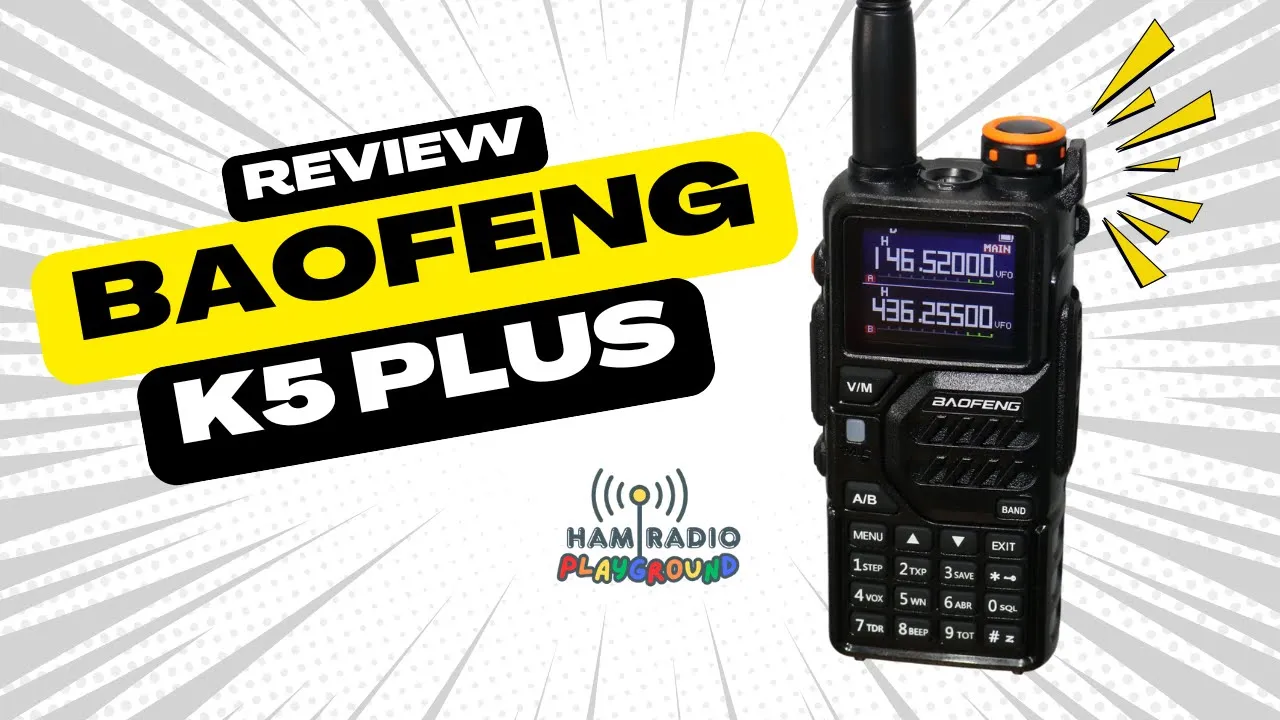
Radioddity sent a Baofeng K5 Plus. He is in a studio that is still being moved, and the review is a first pass: what is in the box, what the screen does, and one unanswered call.
Three Bands in the Hand
He calls it a triband handheld. 2 meters, 70 centimeters, and 1.25 meters. A Technician who is short on bands gets three to use. He also calls it a normal radio for anyone, not only a first radio. It fits his hand. Next to a Quansheng, the K5 Plus is a little longer, a little wider, and thicker. The Quansheng has a metal plate around it. This one is plastic. He is not reviewing the Quansheng. Those videos already exist. The UV-5R he wanted for the comparison is in a go can in the garage. He forgot it. His UV-5Rs wear extended packs and are a bit lighter than the Quansheng. They used to live in backpacks in both vehicles.
The battery was already on the radio. He peeled the sticker before recording so he knew the radio worked. In the box: a charger, a speaker mic, a belt clip, a lanyard, an earpiece, and two antennas. The kit they sent is the one-pack mic set, which is why the mic is there. The cord is long enough, the mic is light, it has a clip, and it has a hole if you want to hang it. He has worn heavier mics that drag after a few hours. The earpiece is the usual over-the-ear piece. The radio does VOX. He does not like that. Someone walks up, you answer them, and the radio transmits the conversation. The belt clip is two screws.
The long antenna is the one he said will transmit and receive on all three bands. The short rubber duck will not. He started naming the ranges it does cover and the caption did not land cleanly, so those figures stay out. The desktop drop-in charger confused him for a minute. He counted three pins on the base and two on the radio, and he thought the base might be made for more than one Baofeng. He put the radio in it anyway.
What He Found on the Radio and on the Page
It has dual VFOs, A and B. He later found that both VFOs do not carry every band. AM airband is receive only. FM broadcast is in there too. He used to wonder why a handheld has a regular FM radio. A go bag is the reason he lands on. During the hurricanes in North Carolina, a radio like this could hear what was happening and still transmit on the ham bands. NOAA weather is on it. Memory is 999 channels. Frequency copy clones one radio to the next, tones and codes included, which is the feature he would want for search and rescue or for ARES and RACES. Repeaters can be entered on the keypad. You do not have to have the computer.
The battery charges on USB-C, a port on the pack. He wishes that port programmed the radio. It does not. Programming is a Kenwood-style plug, the same jack as the mic and the earpiece. The cover was tight because the radio was new.
On the product page he reads triband VHF, UHF, and 1.25, plus airband, NOAA, and FM receive. The page also says it receives 1 meter. He does not know that range from memory. Power is 10 watts, unlike the UV-5R he is comparing it with. High, medium, and low are 10, 7, and 4. One-key copy is listed again. Charging is the cradle or USB-C. CHIRP is listed. He tells people not to flinch at open source. You can read what went into it. Closed software is the thing you cannot see. His line for the argument is not to let the dinosaurs ruin the day.
The screen is color. He read 1.77 inches off the page. White text on blue was fine. What he did not like was a color shift when he transmitted, which made one frequency hard to read. It was not doing it during the video. He had factory reset the radio, and he thought he might have been in channel mode, so it may have been a setting. In the menu the text is red on blue. He wishes that color could be changed. He is not interested in the scramble setting. The menu also has a stopwatch, power-on behavior, reset, voice, a power-on message, a logo, and a voltage display. Offsets and a Roger beep are in there. The beep can be on or off. Voice prompts can be off. There is a flashlight and a strobe. Scan runs, and it felt slow. The squelch key was not doing what the label made him expect. He turned that behavior off. The displayed frequency looked a little off to him. The digits in the caption are not clean enough to repeat. He identified as KE2DFQ. Nobody was waiting on the other end. He had not set that up. He said so, because the call was live.
Thirty-Two Dollars
The number he uses is $31.99, plus shipping as far as he knows, and he keeps rounding it to $32. The description has a code for a discount. They sent the radio. He says he would have thought about buying a couple anyway.
He has hit a couple of repeaters a few miles from the house. That is the testing so far. A later video is supposed to take it outside. He wants to run Winlink through it. APRS would be a Raspberry Pi on the outside, because the radio does not do APRS.
His comparison for the price is a Yaesu, an Icom, or a Kenwood handheld at $500 or $600 that you are afraid to clip on and afraid to drop. If the $32 radio breaks, he calls it the cost of dinner. A go pack, a camping pack, a day hike, or the house. He thinks a license will cost more than the radio, and he does not accept “the hobby is too expensive” from that.
The studio move is why the bench looks unfinished. He names the other channel, Freedom Maker Lab, for 3D printing, building, and electronics, and he goes back to putting the room together.
Transcript
Kevin is opening a box from Radioddity. It is a Baofeng K5 Plus. He calls it a triband radio and a good beginner handheld, and then he takes “beginner” back. It is a normal handheld at any point in the hobby. A Technician gets three bands: 2 meters, 70 centimeters, and 1.25 meters.
In the hand it fits. Next to a Quansheng it is slightly longer, slightly wider, and beefier. The K5 Plus is all plastic. The Quansheng has a metal plate. He is not reviewing the Quansheng. The battery is already on. He peeled the sticker off before the video so he knew it worked. The box has a charger, a mic, a belt clip, a lanyard, an earpiece, and a couple of antennas.
He puts an antenna on. Frequency mode, the usual A and B, dual VFOs. It receives AM airband and does not transmit there. It receives FM broadcast. He used to wonder why that feature is in a handheld. A bug-out bag is his answer. The hurricanes in North Carolina are the example: hear what is going on, where emergency services are, where the damage is, and still talk on the ham frequencies. The battery is USB-C. He wishes programming used that port. It does not. The Kenwood-style plug programs it and also takes the earpiece and the mic. The cover is tight because the radio is new. The mic on the belt is how he would work an event, radio clipped, mic in the hand.
NOAA weather is on it. 999 memories. Frequency copy clones one radio to another, which he likes for loading repeaters in the field. Repeaters can be programmed from the keypad. CHIRP works. He wishes the UV-5R were on the bench. The studio is mid-move. The UV-5R is in a go can in the garage. The Quansheng is the stand-in because the size is close. The Quansheng is a little heavier than his UV-5Rs, and those UV-5Rs have extended packs. They lived in backpacks in the vehicles for a while.
He puts the price at $32, then $31.99 plus shipping, he assumes. A code in the description is a discount. Radioddity sent the radio. He is not worried about dropping it. The lecture he is answering is the one that says you need a Yaesu, an Icom, or a Kenwood, and then you spend $500 or $600 and worry every time it is clipped on. If this one breaks, he says you are out the cost of dinner. He has hit a couple of repeaters a few miles away. Not much other testing. Field tests are coming. He wants Winlink through it, and APRS by way of a Raspberry Pi, because the radio itself does not do APRS.
He reads the page. Triband UHF, VHF, and 1.25. Airband, NOAA, FM. It also claims 1-meter receive, and he does not know that range offhand. 10 watts. The UV-5R he is thinking of does not. High, medium, and low are 10, 7, and 4. One-key copy brings the frequency, the tones, and the codes. Search and rescue, ARES, or RACES can clone a set of radios. Charge in the cradle or with USB-C on the battery. CHIRP. He says open source means you can see what is in it, and not to let the dinosaurs ruin the day.
The kit is the one-pack mic set, so the speaker mic is in the bag. The cord is a decent length. It is light, it has a clip, and it has a hole to hang it. Heavy mics wear on you after a few hours. The headset is an earbud style he has not used much. Security work is the case he can imagine, when your hands are not free. VOX is supported. He does not like it. A person walks up, you talk to them, and the radio transmits. The belt clip takes a couple of screws.
The short rubber duck does UHF and VHF and not all three bands. The longer antenna is the one for all three. He names a couple of ranges and they do not come through cleanly. The desktop charger has a pad layout he was not expecting, three pins against two on the radio. He thinks other Baofengs may use the same base. He sets the radio in it.
The page says a 1.77-inch color screen, and it has one. A color change when he keyed, earlier, made the active frequency hard to read. It is not doing it now. He factory reset the radio, so it may have been a setting, or channel mode. White on blue is what he is looking at. There is a flashlight. He hits the FM-radio button by mistake, then finds the light, and a strobe. Scan is in there. He turns voice prompts off. The Roger beep can be on or off. He reads back 2500 milliamp-hours, three power levels, USB-C, 999 channels, frequency copy, NOAA. Programming from the keypad or from CHIRP is the feature he cares about. Expensive radios can be miserable to program in the field. This one is a few settings.
Scan feels slow. The band selection seems off. He will have to fix the screen timeout later. Both VFOs do not get every band. The squelch key keeps doing something else. He turns that off. The frequency it lands on looks a little wrong. The digits are messy in the caption. He identifies as KE2DFQ and calls it a test. Nobody is on the other end. He did not arrange a receive station. He says this is live, and that if Radioddity had not sent it he still might have bought a couple for go packs, camping, hiking, or the house. His answer to “ham radio is too expensive” is $32, and he thinks the license costs more than that. The description has the link and the code. He still has to finish the studio. The other channel is Freedom Maker Lab, for printing, building, and electronics.
Frequently Asked Questions
What bands does he say it does?
Transmit on 2 meters, 70 centimeters, and 1.25 meters. Receive also includes AM airband, which is receive only, FM broadcast, and NOAA weather. The product page also claimed 1-meter receive. He did not know that range off the top of his head. He said you do not get every band on both VFOs.
What was in the box, and what did he say it cost?
Radio, battery, charger, speaker mic, belt clip, lanyard, earpiece, and two antennas. Radioddity sent the one-pack mic kit, which is why the speaker mic is there. He peeled the sticker off the battery before the camera rolled. He called it $31.99 plus shipping, and about a $32 radio. A code in the description was a discount. He had already worked a couple of repeaters a few miles away and said the real field tests were still coming.
How do you program it and charge it?
CHIRP, or the keypad. He said you can put a repeater in from the front panel, tones included, and you can clone one radio to another. The programming jack is the Kenwood-style plug. It is also the jack for the mic and the earpiece. USB-C charges the battery and does not program the radio. The desktop charger is the other way. Its pads looked like three pins to him, and the radio had two. He thought the base might be shared with other Baofeng models. He set the radio in it anyway.
What did he not like?
The menu was red on a blue background and hard to read, and he wished the transmit highlight color could be changed. He had factory reset it, so he was not sure the earlier color flash was a setting. Voice prompts and the Roger beep can be turned off. Scan felt slow. VOX will transmit if someone walks up and starts a conversation. The radio does not do APRS. His plan was a Raspberry Pi later. He also forgot the UV-5R in a can in the garage, so the size comparison on camera is a Quansheng, which is a little smaller and has a metal plate. The K5 Plus is all plastic.