
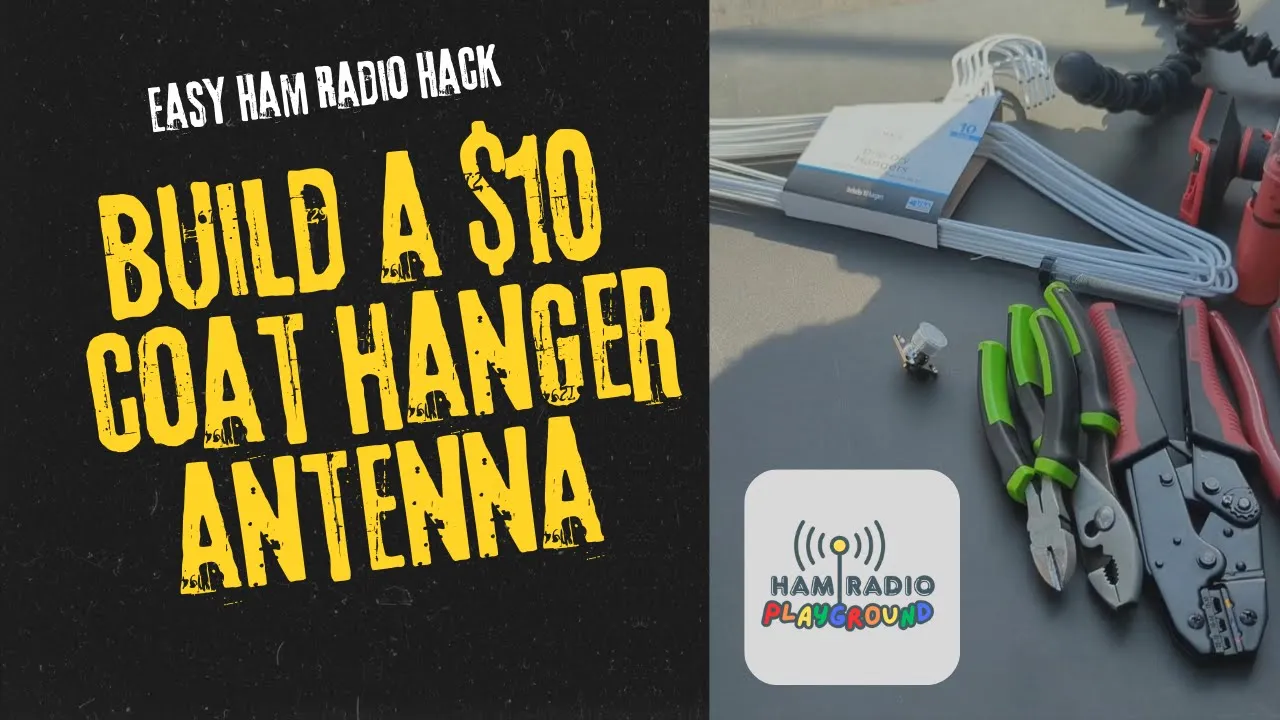
A quarter-wave ground plane for 2 meters is five wires and a connector. This one is coat hangers. The target is the middle of the band, 146 MHz, and every element is 19.2 inches.
Cut Each Element to 19.2 Inches
The half-wave number is 468 divided by the frequency in MHz. A quarter wave is half of that, so the elements are 234 divided by the frequency. The 2-meter band runs from 144 to 148 MHz. 146 sits in the middle. 234 divided by 146 is about 1.60 feet. Times 12 is 19.2 inches.
Cut five pieces at that length. One is the driven element. Four are the radials.
Nineteen and a quarter inches is 19.25, so the mark in the video is 19 and a quarter, then back one line on the tape. The first clean piece becomes the gauge for the other four. Close is enough if each one is about 19.2.
What the Parts Cost
Half of a Walmart 10-pack of wire hangers. The pack was $2.48, so five hangers were $1.24. Twelve-gauge copper or old Romex will replace them. Buying new Romex for this did not make sense to him with the price of copper.
Four ring terminals from a Home Depot 15-pack priced at $4.38. The four he used were $1.16.
Four #6-32 bolts and four #6-32 nuts. Walmart had a 17-pack on clearance for a quarter, which put about half a cent on this antenna. He remembered the normal price around $1.20. Home Depot and Lowe’s sell packs of 10 to 20 for about $1.50 to $1.60.
A 2-foot piece of 3/4-inch PVC. Home Depot had it at $2.11. A veteran discount took his copy to $1.80, and he still counted $2.11.
An SO-239 chassis connector. He already had them, from a 3-pack on Amazon at $9.99, so one connector was $3.33. A radio shop, a hamfest, or an electronics store will have them, and that price moves.
The antenna total was $7.84 and a half cent. Coax is not in that number. A 10-foot jumper with PL-259s on both ends was $9.99 on Amazon if you need one.
The tools are strippers, a crimper, snips, pliers or a nut driver, a screwdriver, a soldering iron, solder, and a tape measure. The iron in the video is a butane one from Napa. He no longer remembers if it was $10 or $15. A cheap plug-in iron is enough.
Bend the Radials to 45 Degrees
Cut the hanger just after the bend. Leave the twisted hook alone. He started to untwist one, stopped, and cut it instead. Straighten the wire, cut a clean end away from the twist, measure 19.2 inches, and cut again.
Strip one end of four wires for the ring terminals. Strip the fifth a little longer so it seats in the center pin. The bare wire should reach the edge of the ring and not cover the hole. Crimp the barrel, crimp it a second time, and tug it.
Scotch 33 or marine heat-shrink covers the crimp and the bare cut at the other end. The marine tubing in the video is a 42-piece Harbor Freight box, three or four dollars. The coating on the hanger melts and fills the tip. Skip that seal if the antenna stays indoors. Plasti Dip is the other option he named.
Solder the fifth wire into the SO-239. It sits a little loose until the solder takes. A short bit of wire above the pin is fine. Two sizes of heat-shrink finish it: one over the body of the connector, one down onto the hanger.
Bolt the four rings to the flange, hand tight. Bend each radial down to about 45 degrees, then tighten.
Put the coax out the side of the PVC, not the bottom, so the pipe can slip over a mast. The hole has to clear the connector at an angle, about an inch or more. A step bit, a Forstner bit, or a paddle bit will start it. He opened the rest with snips. Take the sharp edge off with a file, the iron, or tape before it cuts the jacket.
What the Meter Showed
The test stand was a pole zip-tied to a table, a couple of feet off the ground, next to a dumpster. The radio was a Quansheng handheld he won as a hamfest door prize. The rubber duck opened a local repeater. The handheld connector is not a PL-259, so an adapter went on the same coax, and the coat hanger opened that repeater. He identified as KE2DFQ.
On the RigExpert, the SWR started at 1.25 to 1 at the low end of the band and rose a little from there. At 146 MHz it was 1.32 to 1, moving between 1.3 and 1.32. Before every radial was down at 45 degrees, he was seeing about 1.5 to 1. The NanoVNA plot ran from 142 to 148 MHz with 146 in the center and a Smith chart behind it.
He does not treat that as the final number. The next check he wanted was the same antenna on a mast, away from the dumpster and the dirt.
After the camera stopped, a friend got on the radio with him. They worked repeaters out at the edge of the Syracuse area, and the audio sounded like the same room in both directions. Grant, a few miles up the road, joined that contact.
The close of the video is the reason he built it on camera. A radio around $10 or $15, a Baofeng if that is what you have, about $8 in parts, and a few hand tools.
Transcript
In this episode we are building a quarter-wave 2-meter antenna. The catch is the price. The whole thing comes in under $10, from coat hangers and parts at the usual box stores. It is a quarter-wave ground plane, and it is meant to be an easy first build.
A half-wave element is 468 divided by the frequency in megahertz. A quarter wave is half of that, so the number to use is 234 divided by the frequency. This one is for 2 meters, 144 to 148 MHz. 146 is about the middle of the band, so that is the frequency in the formula. 234 divided by 146 is 1.6027 feet, call it 1.60. Multiply by 12 and each element is 19.2 inches. A ground plane needs five of those. Do not cut yet.
Five wire coat hangers. A 10-pack at Walmart was $2.48, and half the pack is $1.24. Twelve-gauge copper, or old Romex if you already have it, skips that cost. He would not buy Romex at a big-box store for this, not at the price of copper.
Four ring terminals. Home Depot sells a 15-pack for $4.38, so four of them are $1.16. Four #6-32 bolts and four #6-32 nuts. A 17-pack at Walmart was on clearance for a quarter, which is about half a cent on this antenna. He thought the normal price was about $1.20, and Home Depot and Lowe’s sell packs of 10 to 20 for about $1.50 to $1.60.
A 2-foot piece of 3/4-inch PVC was $2.11 at Home Depot. His veteran discount took it to $1.80, and he left $2.11 in the total so the number matches what everyone else would pay.
An SO-239 chassis connector. A local radio shop, a hamfest, or an electronics store may have one. He already had some, from a 3-pack on Amazon at $9.99, so his connector was $3.33. Your price depends on where you buy it.
That is the parts list, plus coax and tools most shacks already have. The total is $7.84 and a half cent, because the nuts and bolts were a quarter. A 10-foot coax cable with PL-259s was $9.99 on Amazon if you need one.
Tools: wire strippers, crimpers, snips or dikes, pliers or a wrench or nut drivers, a screwdriver, a soldering iron and solder, and a ruler or tape measure. Inexpensive irons are a couple of dollars at Walmart, Home Depot, Lowe’s, Harbor Freight, or an auto-parts store. The iron in the video is a butane one from Napa. He has had it so long he does not remember if it was $10 or $15. Another video, linked from the description, covers where to pick up basic tools cheap. Let the tool kit grow with the station.
The build is not dinosaur approved. If one barks, brush it off.
He shows the finished antenna, then goes back to the start. Cut a hole in the side of the PVC so the coax comes out there instead of the bottom. Then the pipe can slip onto a mast. The hole has to be larger than the connector, because the cable enters at an angle. About an inch, maybe more. A step bit, a Forstner bit, or what he actually did: a paddle bit to start the hole, then snips to open it until the cable fit. File the edge, melt it with the iron, or tape it, so it does not nick the jacket.
On the hangers: do not untwist the hook. He started to, called it a production incident, and took it back. Cut just after the bend, on either side. A hanger is long enough. Then you only straighten one area. Pliers will take the remaining bends out if you want them perfect.
Measure 19.2 inches from a clean end, away from the twisted scrap. He nicks the spot and cuts it. The first piece is the measuring stick for the rest, because filming and measuring at the same time was a pain. The tripod stayed home. Five pieces, each about 19.2. Straighter is optional.
Strip one end of each. Four get ring connectors. The fifth solders into the SO-239, so that one is stripped a little longer. Take off only enough for the connector to bite bare metal.
Seat the wire at the edge of the ring. Too much bare wire blocks the hole. Crimp the blue barrel. Ratcheting crimpers make that easy. He crimps twice, once at the front and once further down, then tugs the joint. Heat-shrink is optional and was not in the original parts list. Scotch 33 does the weather seal too. He prefers marine-grade heat-shrink from Harbor Freight, a box of 42 pieces for three or four dollars. The same tubing goes over the cut tip so it does not rust. Plasti Dip is the other coating he mentions. If the antenna lives indoors, skip the weatherproofing.
Four short pieces of tubing slide over the crimps before the heat. A heat gun, a hair dryer, or a big lighter will shrink it. Marine tubing is what he wants outside, because it is made to get wet. Plain heat-shrink works. Glue-lined tubing works. The hanger’s own coating melts and backfills the tip, which helps the seal. Leave a little tubing hanging past the end so it tightens down.
Pop the plastic cap off the SO-239 and solder the fifth wire into the center hole. A butane iron is what he uses in the field. He also has a cheap plug-in iron and a station for circuit boards. The butane one fills like a lighter. The wire is a little loose until the solder locks it. Extra wire above the pin is fine under the heat-shrink. Let it cool. Two sizes of tubing finish that joint: a larger piece over the end of the connector, and a smaller piece that actually seals against the coat hanger.
Screw the radials on hand tight, one at a time, and bend each one down to 45 degrees. Then tighten.
The PVC in the test is zip-tied to a pole on the table so he can film it. The radio is a Quansheng handheld, inexpensive, won as a door prize at a hamfest. He keys a local repeater on the whip and gets a tone back. Then the same radio goes onto the coat hanger. The handheld needs an adapter. The coax up to the antenna is the same cable. He keys again, identifies as KE2DFQ, and the repeater comes back.
That is the build. A simple first antenna.
The RigExpert sweep is the performance check. SWR starts at 1.25 to 1 at the low end of the band and climbs slightly across it. The antenna was cut for 146. Right at 146 the SWR is 1.32 to 1, moving between 1.3 and 1.32. The first repeater test was done before the radials were fully down at 45 degrees, and that reading was about 1.5 to 1, which he still did not consider bad. Bending them the rest of the way improved the sweep. The NanoVNA plot runs from 142 to 148 MHz, center 146, with a Smith chart in the background.
He does not call it top notch. A dumpster was next to the test, and the antenna was only a couple of feet up. He wants the same measurement on a mast, away from metal, because the surroundings may have been in the numbers.
What he did not get on camera: as he packed up, a friend called. They hit several repeaters on the outskirts of greater Syracuse, which is where he was. The other station sounded like he was in the same room, and the receive was the same. Another local joined. That was Grant, a few miles up the road, with a much bigger antenna farm. The coat hanger made the contact.
His close: there is no honest way to say the hobby is too expensive to start. A $15 radio or a $10 radio, depending on the package, or a Baofeng, about $8 in locally sourced parts, and a couple of tools. Then you are on the air.
Frequently Asked Questions
How long is each wire?
19.2 inches. The quarter-wave formula he uses is 234 divided by the frequency in MHz. For the middle of 2 meters, 146 MHz, that is about 1.60 feet, which is 19.2 inches. Cut five pieces.
What did the parts cost?
$7.84 and a half cent. That is half of a $2.48 Walmart hanger pack, four ring terminals out of a $4.38 Home Depot 15-pack, a clearance pack of #6-32 bolts and nuts that put about half a cent on this antenna, a 2-foot piece of 3/4-inch PVC at $2.11, and one SO-239 out of a $9.99 three-pack. A 10-foot coax jumper with PL-259s was another $9.99 if you do not already have one.
What SWR did it show?
About 1.32 to 1 at 146 MHz, moving between 1.3 and 1.32, after the radials were bent to 45 degrees. Before that bend it was about 1.5 to 1. The low end of the band started at 1.25 to 1. The antenna was a couple of feet off the ground next to a dumpster.
Do the elements have to be coat hangers?
No. Twelve-gauge copper or a scrap of old Romex does the same job. He used hangers because a 10-pack at Walmart was $2.48, and new copper from a big-box store was the expensive way to do it.