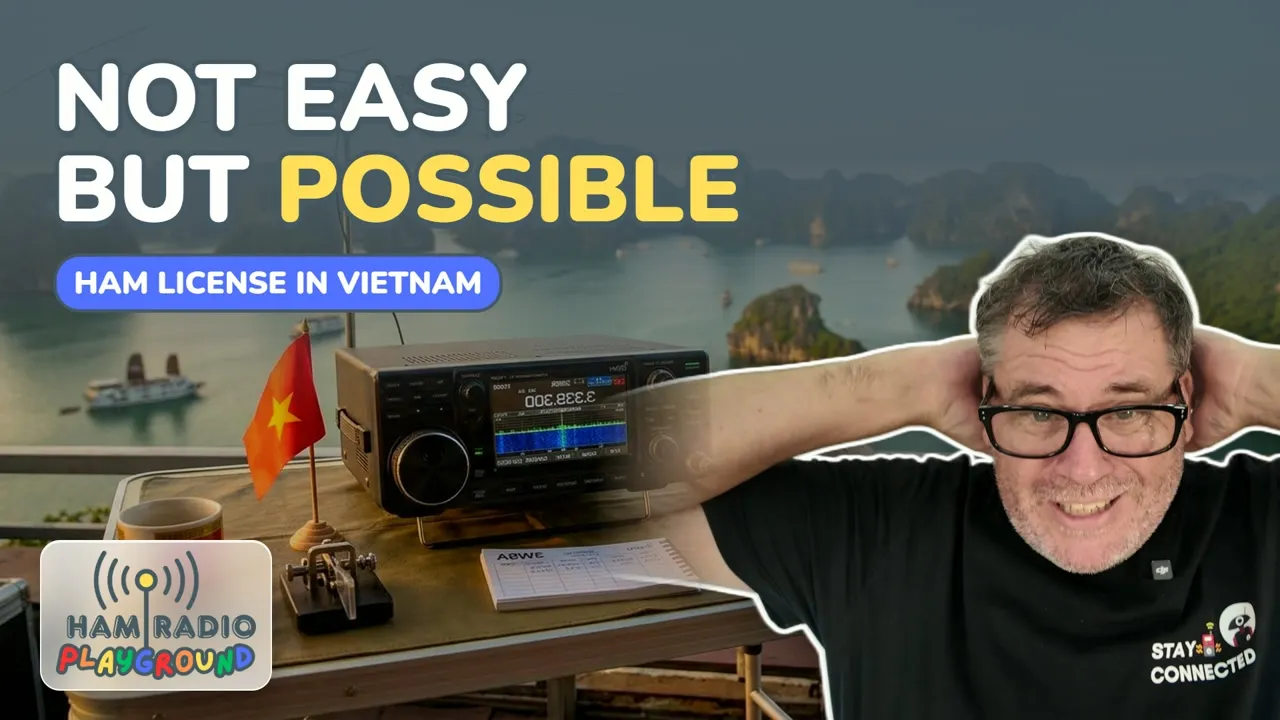
It can be done. He says that first, because the story people told him was that the club would never answer. The man who runs it is in his mid-nineties, in poor health, and silent for months at a time. There is no portable operation in Vietnam. He is already sitting on about 200 contacts from a couple of days on the air.
Kevin, KE2DFQ, and now XV9KV. He spells the Vietnam call. The U.S. license process, he says, is nothing. He will take the FCC every time.
Before the Window
He tried the only club for months before he moved, and again after. Email, the home number he found, a personal address on top of the club address, other people at the club. Nothing. For a foreigner the club was the path. Test in as a citizen, or show an equivalent license and be given one here. No answer, no process. He let it sit, and then he wanted a radio bad enough to start again.
Small SDRs, receive only. Doughnut antennas, a short whip, not much to hear. One night on PSK Reporter, a station south of him, receive only, reporting what it heard. QRZ, an email. He was in Da Nang and trying to get licensed. That operator could not help. Tested, and a year later still no license, waiting on the same club. He did have two names.
The local one was wary. “I don’t know what you’re talking about.” Kevin tried again, in case it was the English, through a chat app and then a Vietnamese paste from Google Translate. The reply was that Kevin wanted to buy a radio. He did not. He wanted a license. “I don’t sell radios.” Two days of ordinary messages. A photo of a shack. He does sell radios. The rest of it bothered Kevin. Activations on the beach, shut down before anyone noticed. FT8, and no answer when the question was which logger. The call sign, asked more than once, never given. A meeting that would not include an address. He stopped trusting it.
The other name was a foreigner. QRZ, a map, an American, a U.S. call and a Vietnam call and others. Come over. Eighteen years. If the license landed, Kevin would be the third foreign operator that man knew in the Da Nang area. The second lives about an hour away, about 25 years in the country, not American. Kevin thinks England and has not met him. A hex beam, other wire antennas, the radios, an afternoon. The club, this man said, was not going to answer. Two other contacts Kevin had already emailed, also silence. Then do it yourself. Frequency office, an application, paperwork. His wife had just been there. He wrote the address down.
Kevin already knew, from what he had read, that a foreigner’s license expires with the visa. A Bangkok run was coming. He was not going to file a license that would die in a few days. He waited until he was back.
Science and Technology
The sign said frequency management. Translate, past the guard, a wave, then a finger down the street and no English. A paper in the window. Photo translate. As of the end of July, that office does not take radio applications. Science and technology does. The address is the central administration building in Da Nang.
A room of about twenty windows. A kiosk, a ticket, a queue. The information desk had no idea what he wanted until he said science and technology. He sat down without reading the small sign. Translate: amateur license, based on the U.S. license, foreigner, science and technology. She laughed, in English. She is that department. That was most of her English. She had never done one. A colleague came down. Very few, she said. They printed the form.
He had already studied someone else’s translation of the fields. Name, which address, the frequencies. A Vietnam license is tied to a radio. Make and model. Everything he had read said to bring the serial number. They did not want it. They wanted the address he would operate from. No portable. He had been a Parks on the Air operator. The only person he has talked to who activated a park in Vietnam told him, before the move, good luck. The approval that one time used the address of the campground inside the park.
A second form for the radio. A third for the person and the house. Modes are not “phone” and “data.” They want the modulation written out.
The U.S. license. She called it a photocopy and asked for a certified copy. He explained the PDF. You print it. There is no seal. She said that would not work, and that the PDF is all the United States issues. They were already on the phone about which other papers mattered.
The address on the form does not exist, they said. It is the address on his police registration. Foreigners register where they live. That part is the other channel. Google will not find the street. The name changed. They told him Vietnam does not rename streets. Neighbors, the landlord, and the agent all told him it had. The signs on that street are painted white. He pulled up the Google Maps point that does resolve. They said that was the address they would use. It would not match the registration. He texted the agent. She sent a deed the landlord had, with the address on it. That was enough.
Passport, copied and certified. The application, certified, because of the signature. The U.S. license, certified and translated. An address for that office. And the club certificate. He laughed. Ten months, nothing. They laughed and told him to find another way. Did he know anyone else in the sport. Their word. He had been told good luck. More calls. Then the colleague’s phone, a smile, and a translation pushed to his screen. The law had changed. The man was too hard to reach, and in poor health. His signature is no longer required.
The Wrong Stairs, Then the Wrong License
They sent him for the stamps. After 5. A small room like a classroom off to the side, and a government building with a stair. He took the stair. Empty. Blinds down. A government office after 5. Thursday, he thinks. The small room still had people. He did not know that was the desk. It could have been finished that day. Friday he did not feel well enough, and it was raining, and he was not riding across town for it. Monday.
Monday he climbed the same stair. The window sent him next door. The address differs by a letter. They could do the passport and nothing else. A supervisor came down. Another building, a named person. He waited. She nodded that she was the person, and before he said what the papers were she told him she could not help him. He is not Vietnamese. Call the embassy. He had not finished the sentence. He did not answer her out loud. The embassy does not translate this kind of paper. An official record they can pull from a government is a different procedure, and there is no embassy in Da Nang. Ho Chi Minh City.
Back to the science window. She thought he was done. He was not. Passport only at the first place. The second place told an American to leave. She said that was not how it should have gone. She apologized. Not her fault. A new address.
Six windows or so, another ticket. This clerk could endorse the application and needed a second copy, because they keep one. She could translate the license and she could not certify it. Nothing to trace. He said he had two copies and pulled the wrong sheet. General radiotelegraph, not amateur. He did not check. GMRS, that telegraph license, and the ham license, two of each. The telegraph ticket and the ham license match except a line at the top and the call.
Out for a photocopy. About 11:15 or 11:20. Offices close at 11:30 and open around 1:30. He does not like the moment they unlock the door. They may not be back when the sign says. An extra copy of the application, so he would have one. Afternoon, two applications, stamps, done. The translation is not same-day. A couple of days.
He picked it up and did not read it. Science and technology. She liked the pile. A printout from the computer, Vietnamese, a receipt. Eleven business days, or more, before they would even say whether a license was possible. He had thought he was finished.
The translation desk had refused him at first. The science clerk had given him her number so he could send the PDF. They wanted the file itself, to check the signature. A call from her is what got the translation started. A week later she messaged him. They had a problem. The translation was wrong. He went to that office instead of back to her. They were already on the clerk. Line by line, his name, the address, fine. The serial number, which on this form is the call sign. He knew. A blank copy was still in the folder. She had translated one page, copied the translation, stapled both, and not compared them. A ham license on a translation of the other ticket.
Another 100,000 dong. He calls it four bucks. A couple of days. His mistake. Ten months, and four more days.
The Paper
He texted her before he walked in. His fault, one right form and one wrong. She was nervous. She was holding the real amateur license and the wrong translation. The packet was already in the desk. She signed, and she put it in front of him. The approval had been sitting there. She needed the pages to match. The call had been issued days earlier. He could not use it until she handed it over.
A QR code. That is how the fee is paid. He does not know the number. An application fee and a license fee. He paid for about two months. A couple of weeks into October. October, November, a visa that ends in mid-December. Operate until the visa ends.
Renewal, she said, is 30 days before it expires. He is on a 90-day visa. Thirty days early turns it into 60. She made calls. Maybe 10 days, and she would not promise. He is looking at longer visas.
XV9KV. The radio on the grant is the FT-710, because that is the only radio he put on the form. He asked for 160 through 6. They denied 6. He asked for 2 meters and 70 centimeters. They gave him 2 meters and left 70 centimeters off. He is not going to fight it. He does not know if they skipped the line. He does not plan to live on VHF. Six meters, he has been told, is military. He has also been told it is quiet and that people operate and are left alone. It is not on his license. He will not give them a reason to refuse the renewal.
The House
The ATAS is not on a vehicle, so the ground is the whole problem. Long counterpoises have worked, sometimes. Third floor. The front balcony never got a ground he could make a contact on, and the power lines are there. The back balcony is the one that has worked. Shorter wires, about 16 feet, he is not sure. The longer ones he thinks are 33 or 31. Down, then out, toward the ground. More wire is on the way. An end-fed half-wave is in the room and has nowhere to go. The roof is metal. He would have to get well above it. He is not sure he wants that. An Alpha mag loop is coming. The front balcony, off the shack, is where he thinks it will sit.
One side of the house is an empty lot, until someone builds. A neighbor on the other side, and empty past him. The lot behind is empty. Behind the neighbor, two houses just went up, so the empty lot may not last. Chickens on the far side. Wire has to be up, or they will chew it. Telescoping poles ordered from China arrived as ballpoint pens. Refund. Local ideas are tent poles, bamboo, garden stakes, shorter than the 9 feet, the 3 meters, he had been looking at. A DX Commander expedition pole is on the way from the United States. No radio distributor on the corner. Used gear is hard. They want new. Anything that transmits tends to get stopped.
About 200 contacts in a couple of days. Compromised antennas. Japan, China, the Philippines, Indonesia, Australia. The end of the week before, a opening. Africa, most of Europe, some of the space between, India, Alaska, and he was spotted in California. He wants the East Coast and the people who still want a Vietnam contact. Often he does not have to call CQ. He answers someone else and the frequency fills. Most of it is FT8.
Reviews of what he buys, yes. Sponsored boxes, less so. A couple of companies wrote, heard Vietnam, and stepped back. They will not ship it direct. The freight forwarder, also no. He liked the free gear. He also paid for plenty of it before. He still buys from the companies that said no. A pile of his own equipment is sitting in Syracuse.
A mini PC he bought will not run the radio. The USB ports shut down on transmit. Not the computer. The ports. He was trying to replace the usual stack, Grid Tracker, WSJT-X, the logger. Same failure inside WSJT-X alone. He blamed Linux, put Windows back, and got the same thing. The ports are wired like a hub and do not supply the power. A powered hub might fix it. USB 2.0, not 3.0, so the link is slower, and it has to be powered. He may have to order one. There is no Amazon here.
Both calls, if you run an alert. He still uses remote stations in the United States sometimes. That video is coming. KE2DFQ, and XV9KV.
Transcript
Possible, and not easy. The club man is in his mid-nineties. No portable operation. About 200 contacts in a couple of days. KE2DFQ, and XV9KV. He will take the FCC process over this one.
Months of email and calls, before the move and after. Nothing from the club. Small receive-only SDRs, not much heard. A PSK Reporter station south of him was still waiting a year on the same club, and gave him two names. The local one heard “buy a radio,” then showed a shack, talked about beach activations, would not name a logger or a call sign, and would not give an address. The American, 18 years, found on QRZ, said a license would make three foreign operators he knew of in Da Nang. The other is about an hour out, about 25 years, maybe England. Hex beam, wire, an afternoon. Do the paperwork yourself. Kevin waited out a Bangkok visa run because the license dies with the visa.
The frequency office had closed at the end of July. Science and technology, a room of about twenty windows, a ticket. She laughed. She is the department. Never done one. Colleague, very few. Make and model, not the serial number. The address he will operate from. No portable. The one park activation he knows about used a campground address. Modes spelled out, not “phone” and “data.” The U.S. PDF is not a certified original. His street name is not on Google. The signs are white. A landlord’s deed fixed the address. The club letter came off the rules in a phone call while he sat there.
After 5 on a Thursday he took the wrong stairs. The small room was the desk. Friday, rain, he stayed in. Monday, passport only. The next woman told him to call the embassy before he explained. No embassy in Da Nang. Back to science and technology. She apologized and sent him on. That clerk could stamp the application, two copies, and could translate the license without certifying it. He handed her a general radiotelegraph license by mistake. GMRS, that ticket, and the ham license, two of each, and they look alike. Photocopy around 11:15. Offices close at 11:30. Stamps that afternoon. Translation in a couple of days.
He did not read it. The receipt said 11 business days or more. A week later the translation was the wrong license. She had copied one translation onto both. Another 100,000 dong, about four dollars. He told her it was his error. The approval was already in the desk. The call had been issued days before. QR-code payment. He does not know the total. Through mid-December, a couple of weeks into October. Renewal wanted 30 days early. Maybe 10. The grant is the FT-710 only. 160 through 6 requested. Six denied. 2 meters approved. 70 centimeters left off. He will not operate 6.
The ATAS is on the back balcony, with counterpoises around 16 feet and around 31 or 33. The front never grounded, and there are power lines. An end-fed half-wave does not fit under a metal roof. An Alpha mag loop is coming. China poles arrived as pens. Chickens on the next lot. About 200 contacts, mostly FT8. Japan through Australia, then Africa, Europe, India, Alaska, California spots. Sponsors have refused Vietnam. A mini PC drops its USB ports on transmit. Both calls, if you set an alert. KE2DFQ and XV9KV.
Frequently Asked Questions
What bands are actually on XV9KV?
He asked for 160 through 6 meters, and for 2 meters and 70 centimeters. They denied 6. They approved 2 meters and left 70 centimeters off. He will not argue, and he will not operate 6. People have told him the band is quiet and nobody bothers them. It is also described to him as military, and it is not on the paper. The only radio on the application is the FT-710, so that is the radio the grant names.
Why did the translation fail the first time?
His fault. Two copies of the amateur license, two of a general radiotelegraph license, two GMRS. The telegraph ticket and the amateur license look the same except a line at the top and the call. He gave the clerk one of each and left for a photocopy around 11:15. Offices close at 11:30 and open again around 1:30. She stamped the application that afternoon and told him the translation was a couple of days. He picked it up without reading it. Science and technology had a ham license stapled to a translation of the other ticket. He went back, paid 100,000 dong, about four dollars, and told her the error was his.
What has he worked from the house?
About 200 contacts in a couple of days, his count, mostly FT8. The antennas are compromised. Japan, China, the Philippines, Indonesia, and Australia. Late in the week before this video, Africa, most of Europe, some of the path in between, India, Alaska, and spots from California. He wants the East Coast. Call CQ and the pile often starts from someone else's contact. The ATAS is on a third-floor balcony. The front side never grounded well enough, and there are power lines. The back balcony is the one that has worked, with counterpoises he puts around 16 feet and around 31 or 33 feet. An end-fed half-wave is in the room and will not fit. The roof is metal. An Alpha mag loop is on the way. Telescoping poles from China arrived as ballpoint pens and went back. Chickens are on the far side of the lot.